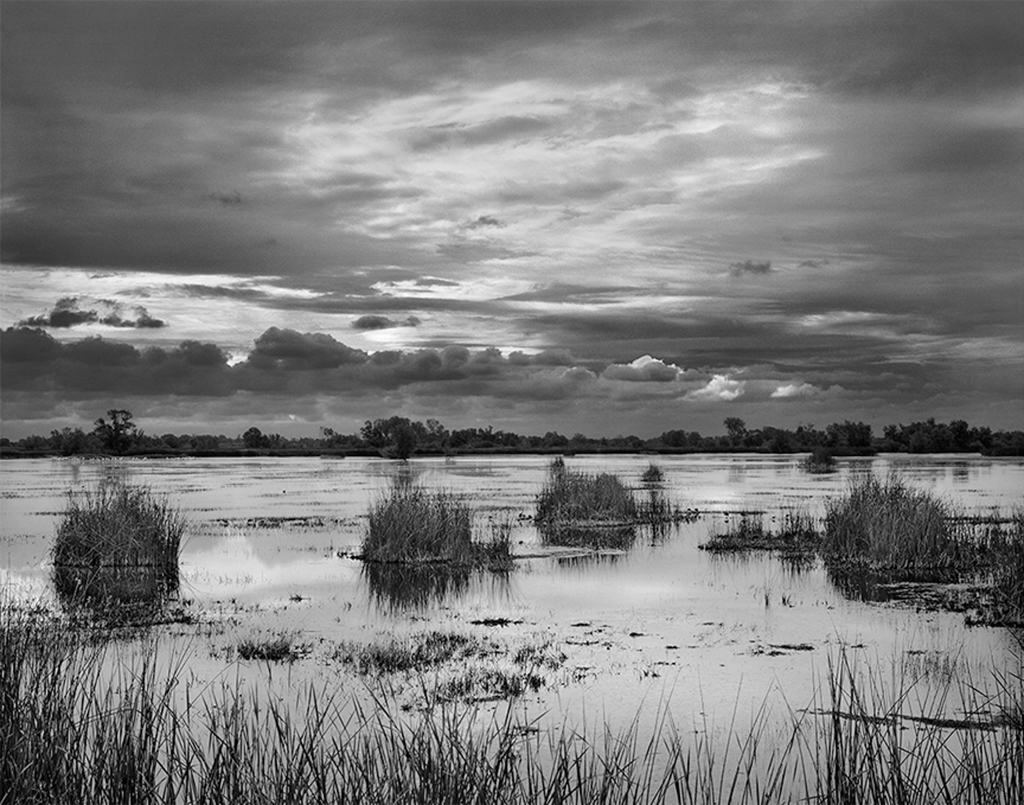
Chris Kilmer: Agrarian Social Landscapes

In his early days as a photographer, Chris Kilmer avoided the Central Valley and its bucolic landscapes, choosing the granite spires and mountain meadows of Ansel Adams and his 'Great Earth ' instead. His perspective shifted dramatically in 1977 when he participated in the Sacramento Survey Grant Project – an 18-month photographic initiative designed to comprehensively capture and document Sacramento’s community, culture, and local lifestyle. So he began taking photographs focused on Sacramento's agrarian social landscapes.
In 1980, Chris moved to Kansas City, where he realized that the Midwest made the Central Valley look like an agricultural Disneyland. As if to apologize for a lack of theater, the local Chamber of Commerce posted billboards proclaiming: "There aren't any mountains in the way". As a photographer of the documentary impulse type, he took stock of landscapes featuring simple lines, calm colors, and horizons that merged into muted textures, and he became enamored with farmlands, barns, grain elevators, flooded wheat fields, and the people who live and work on those lands.
Chris’s Agrarian Social Landscapes exhibit samples photographs he captured during his involvement with the Sacramento Survey Grant Project, his time and travels throughout the Midwest farmlands, and, 13 years ago, his return to the Sacramento area.
Two technical philosophies have become central to Chris’s vision. The first comes from Ralph Talbert, who declared "light replaces color," while the second - Sharmon Goff's work - was expressed in the nuance of color temperature. To this day, Chris uses color negative film and edits to black and white or color in Photoshop. To paraphrase an unknown author: "Consistency for the sake of consistency is to be avoided." Finally, when Chris is out and about doing his free-range backroad touring, he is often reminded of the quip by Roger Vail: "Inspiration is for rookies; the rest of us just have to do the work"